Earlier in the year, I wrote a piece for the TES about these
monstrosities: progress arrows.
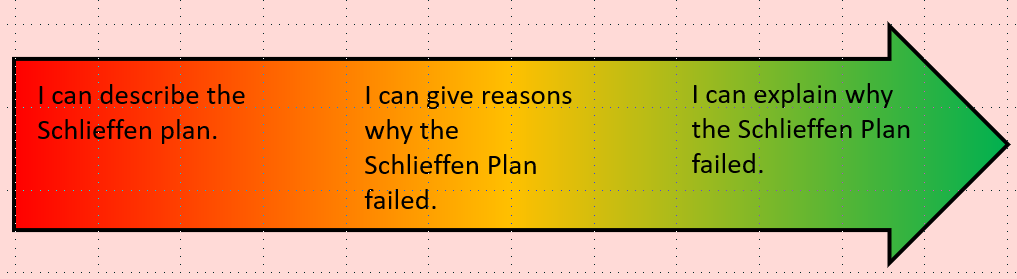
I used these bad boys in the first two years of my teacher career.
The idea was that if pupils could tick the boxes, they had met the criteria for
the lesson, made progress, and proved that I was an amazing teacher. The reality
was that pupils would tick them to make me (or themselves) feel good with
absolutely no actual evidence to prove that they had made any progress. They
were nothing more than transparent attempts to please the invisible Ofsted
inspector.
Thankfully, progress arrows are a thing of the past. After
all, it’s been 7 years. I am now a well-respected and experienced teacher and
head of faculty and with this experience comes wise decisions. Surely I wouldn’t
make the same mistake again? Alas…
The Problem:
Pupils were finding it difficult to retain knowledge in our
subject. We were giving carefully thought out and well-planned explanations,
but frankly there was just too much for pupils to hold in their working memories
at any one time, especially with the new requirement for pupils to complete
four knowledge-intense units at GCSE. It was ridiculous to expect them to
remember everything they had just been taught and to be able to apply it.
The Solution:
Pupils would take notes. Being novices at this new skill,
they would be given sheets to aid their structure (beautifully dual coded with
icons, I might add). In order to ensure that they did not have to divide their
attention between writing and listening (and thus overload their working memories),
we would chunk our explanations, give pupils time to take notes, and then check
their notes with a brief discussion afterwards to ensure that their notes were
of sufficient quality. The process of note taking would force pupils to
synthesise our explanations (thus thinking about it. After all, “learning is
the residue of thought”!) and all pupils would be equipped with knowledge in
their books which they could then further embed through application tasks.
My God, that sounds good. I almost convinced myself again
for a brief second. It looked great as well. During book looks you would find page
upon page of beautifully presented and accurate notes. Check a sample of books
at random and you would find the same quality of information (identical even!).
Clearly I was closing the gaps between pupils in my mixed ability class and
teaching everyone effectively. Pupils even seemed to like it, as well.
The Realisation:
“Miss, what was your second sentence again?”
“Well, I said…*insert History here*.”
“Thanks!” *diligently writes it down word for word*
It was a Friday. My room was dark because it was hot and so
I had all of the blinds closed. I had already invested months into note taking
and had actively encouraged other members of my team to use it. I was gutted.
What was worse is that over the next few weeks colleagues for whom I had great respect confirmed my suspicions and presented well-reasoned
cases against my current approach.
The Reality:
During book looks you would actually be looking at page upon
page of beautifully presented and accurate copying. Fancy copying, but copying nonetheless.
Beautiful fancy copying which took a ridiculous amount of time and actually
allowed most pupils to bypass their brains and go directly from ear to pen.
Beautiful fancy copying which meant that we rarely had time to do any genuine extended
writing and, when we did, pupils were so used to me holding their hands through
every sentence that they were completely unwilling to make even the tiniest of
leaps without me.
Next steps:
We replaced note taking with reading. Rather than forcing pupils
to mechanically reproduce what I was saying, we would cut out the middleman and
give pupils the text, which they could then refer to whenever they needed.
Interestingly enough, I started going down the silver bullet route with this
technique as well, throwing undergraduate-level texts at pupils because I
should be challenging them and they should be reading. Thankfully, (I think) I
caught myself a lot earlier, and we now have a focus on carefully selected and
written texts, with front loaded vocabulary and consolidatory tasks which aren’t
fancy reproduction.
What I’ve learned:
1.
There are no silver bullets in teaching. I’m
sure that note taking can work in some contexts, but just shoving it in because
‘note taking’ and ‘Twitter’ is not reason enough. This is a lesson I had
already partially learned as an NQT, but I think this process has (hopefully!) cemented
it. If I ever say “Well we just need to…and we’re sorted” again, I should have
a proper stop and think.
2.
Neat, full, and even correct books are a poor
proxy of learning. Both as a leader and as a classroom teacher, I should be checking
whether pupils are capable of independently applying their knowledge. On their
own, books with the qualities above are, at best, a poor indicator of this goal
and, at worst, misleading.
3.
It’s never too late to stop what you’re doing if
it isn’t working.
4.
Not doing what wasn’t working doesn’t mean that
the new approach is better.
Comments
Post a Comment